


Tampa Bay Places That Tell the Story of the Region


When friends or family come to Tampa Bay from another city, you don’t necessarily have to take them somewhere every tourist visits. It can be much more interesting to show them places that capture the character of the region: an old hotel that still preserves its 19th-century interiors, a movie theater with nearly a century of history, a neighborhood with a Cuban past, an automobile museum that is nothing like a typical car collection, or a garden that literally grew out of the city’s history.
There are plenty of places like this around Tampa Bay. And some are unusual enough that even for someone who has lived in Florida for years, a visit can still be a reason to be surprised.
Tampa Theatre
Tampa Theatre is one of those places where the building itself can be part of the entertainment. The historic movie theater in downtown Tampa opened in 1926, and its interior was designed to resemble a lavish open-air palace: decorative elements, balconies, columns, and a ceiling with twinkling “stars” create a completely different experience from a modern multiplex.
It’s worth coming here for more than just a particular movie. Tampa Theatre regularly hosts special screenings, concerts, and other events, and its programming often gives visitors a chance to experience the theater itself as a historic landmark.
It’s especially fitting for a guest who loves historic architecture, movies, or unusual cultural spaces. And in 2026, Tampa Theatre is celebrating its 100th anniversary, giving the location another layer of historical context during its centennial year.
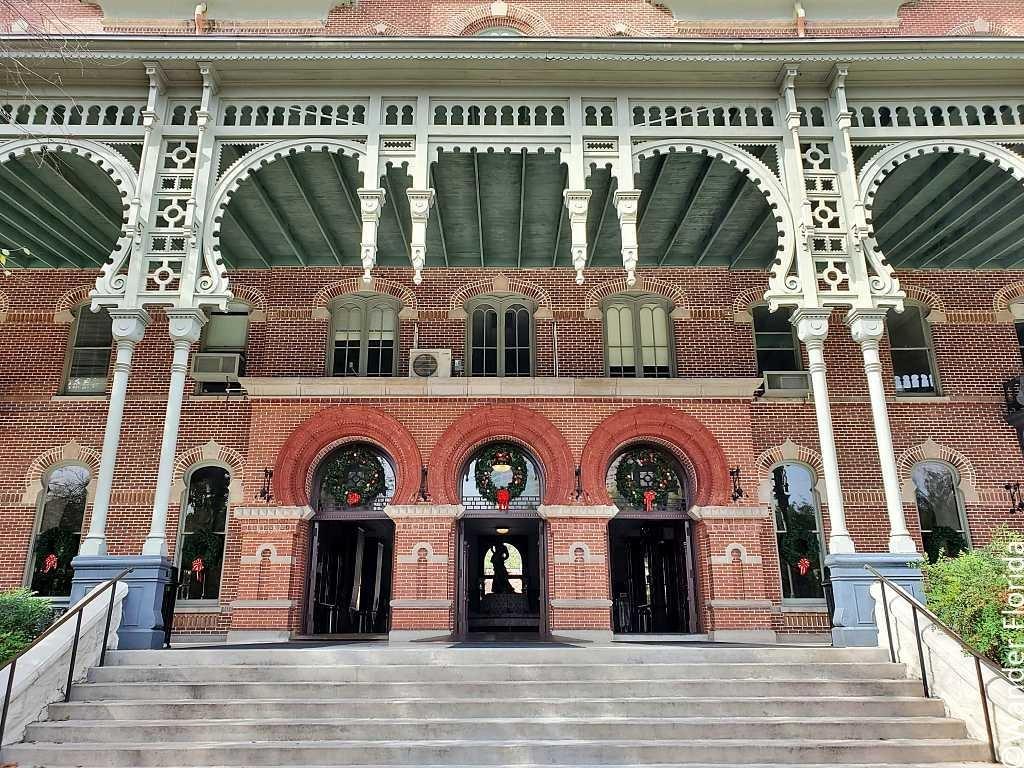
Henry B. Plant Museum is located in the former Tampa Bay Hotel, a grand resort hotel that opened in 1891. Today, part of the building belongs to the University of Tampa, while the museum preserves interiors and objects connected to the era when wealthy guests from the northern United States came here.
What makes this place interesting is that visitors aren’t simply looking at museum exhibits. They are stepping into the actual rooms of a former hotel and seeing what life was like at a luxurious Florida resort in the late 19th century.
Plant Hall’s architecture alone is worth the trip. The building was designed in a style inspired by Moorish architecture and looks nothing like a typical American college campus. The museum is also a National Historic Landmark.
Ybor City is worth showing guests not simply as a neighborhood with restaurants and nightlife. This is a place where Tampa’s history is literally still visible in the streets.
In the late 19th century, Ybor City became a center of the cigar industry and home to immigrant communities, including Cubans, Spaniards, and Italians. Their influence is still visible today in the neighborhood’s architecture, culture, food, and atmosphere.
This is also where one of Tampa’s best-known symbols emerged: the Cuban sandwich. Its history began as food for cigar factory workers, and the modern Tampa-style Cuban sandwich has become a kind of edible history of Ybor City. It brings together ingredients and culinary traditions from different communities: ham is connected to the Spanish tradition, Genoa salami to the Italian tradition, mojo-marinated pork to the Cuban tradition, while Swiss cheese, pickles, and mustard became part of the local version of the sandwich. All of it is placed between slices of Cuban bread and then pressed until crisp. It’s a chance to taste the result of the neighborhood’s history literally in a single sandwich. For a particularly historic experience, you can stop at Columbia Restaurant, which has been operating in Ybor City since 1905 and still makes its sandwich according to a 1915 recipe.
For a deeper introduction to the area’s history, you can visit Ybor City Museum State Park. The museum is located in a former cigar workers’ home and tells the story of the neighborhood’s origins and development.
After the museum, you can simply walk around Ybor City, paying attention to the buildings, old factories, and other traces of the past. As a result, the neighborhood feels less like a collection of bars and restaurants and more like a part of the history that shaped modern Tampa.
FloridaRAMA
FloridaRAMA in St. Petersburg is a space dedicated to Florida art and culture, where visitors can see large-scale installations, unusual visual works, and interactive elements. You don’t simply walk from one informational display to another here: the exhibits are designed for exploring and interacting with the space.
FloridaRAMA works especially well as a place to visit together. It’s the kind of location where two people can come away with completely different favorite exhibits, photos, and impressions.
Sunken Gardens
Sunken Gardens in St. Petersburg is another example of a place that can be easy to underestimate if you only see its name.
The garden began as a private property where its owner created a garden around a natural depression in the land. Over time, the property became one of St. Petersburg’s oldest roadside tourist attractions.
Today, it is a dense tropical garden with narrow paths, ponds, exotic plants, and birds. The experience here is very different from that of a large modern botanical garden: the space is intimate, a little old-fashioned, and has a history of its own.
For a guest from another state, this can be especially interesting because Sunken Gardens shows Florida not through beaches and palm trees, but through one of its unusual old tourist traditions.

Tampa Bay Automobile Museum
Tampa Bay Automobile Museum in Pinellas Park is worth adding to the list even for someone who doesn’t consider themselves a car enthusiast.
The museum’s collection isn’t focused simply on expensive or rare cars. Instead, visitors can see vehicles that are interesting primarily because of their engineering solutions and the history of automotive design.
That’s why the museum can appeal to people who don’t usually visit car museums: here, the automobile is presented not only as a collectible, but as the result of technical experimentation and the search for new solutions.
It’s a good example of a place that is difficult to call a “must-see attraction,” but that can turn out to be one of the best discoveries to share during a visit.
Showmen's Museum
Showmen's Museum in Riverview is dedicated to the history of the American traveling amusement, circus, carnival, and fair industry.
The collection includes objects connected to the people who spent decades moving entertainment from one city to another: old rides, promotional materials, equipment, vehicles, and other artifacts.
This is one of those small specialized places that a guest is unlikely to discover during a typical tourist trip.
Weedon Island Preserve Cultural and Natural History Center
Weedon Island Preserve Cultural and Natural History Center in St. Petersburg combines the natural history of Tampa Bay with the history of the people who lived in the region long before modern development.
The center helps visitors understand the cultural and natural history of Weedon Island, while the preserve itself allows them to continue exploring the area outdoors.
It’s a good choice for a guest who wants not only to see beautiful nature, but also to understand what was here before modern cities, roads, and tourist infrastructure.
Tampa Bay History Center
Tampa Bay History Center is a place for anyone who wants to understand, after exploring Tampa, why the city became what we know today.
The exhibits cover thousands of years of regional history, from Florida’s Indigenous peoples to Tampa’s development as an important port, commercial, and industrial center. The cigar industry, Cuban heritage, and maritime history play particularly important roles in the story.
This museum works especially well before a walk through Ybor City or other historic neighborhoods. Afterward, many of Tampa’s familiar names, buildings, and cultural traditions begin to make much more sense in context.
Imagine Museum
Imagine Museum: Contemporary glass art in St. Petersburg is dedicated to contemporary glass art. The museum features a large collection of contemporary glass works, from sculptures to complex installations. A material that many people are used to thinking of as utilitarian or decorative becomes the basis for large-scale contemporary art here.
For a guest, it can be a good way to see St. Petersburg from the perspective of its art scene without limiting the experience to street art and murals.
American Victory Ship
At the port of Tampa, you can literally step aboard a real historic ship. American Victory is a World War II-era vessel that now operates as a museum.
Visitors walk the decks, look inside crew quarters, and see the ship’s equipment in the places where it was once used for its intended purpose.
Its location near the Channel District also makes it easy to combine a visit with a walk along the waterfront.

The most interesting places for guests in Tampa Bay don’t necessarily have to be the biggest, most expensive, or most famous. Often, a place that lets someone do something they’ve never done before leaves a much stronger impression: step inside a former luxury hotel from the 19th century, watch a movie in a century-old theater, walk the decks of a military ship, find yourself inside a contemporary art installation, or see what life was like in Tampa’s old cigar district.
These are the kinds of places that don’t simply fill a few hours on an itinerary, but give you a reason to show Tampa Bay through its history, culture, art, and the slightly strange but very characteristic stories that belong to the region.


ABOUT TampaBayTide
FOR BUSINESS