


Where to See Roseate Spoonbills in Tampa Bay – and Why They’re Pink


If you’re walking along the Tampa Bay shoreline and suddenly spot a group of large pink birds with long legs and remarkable flat bills, don’t be too quick to think you imagined them. They may be Roseate Spoonbills – some of Florida’s most unusual wading birds.
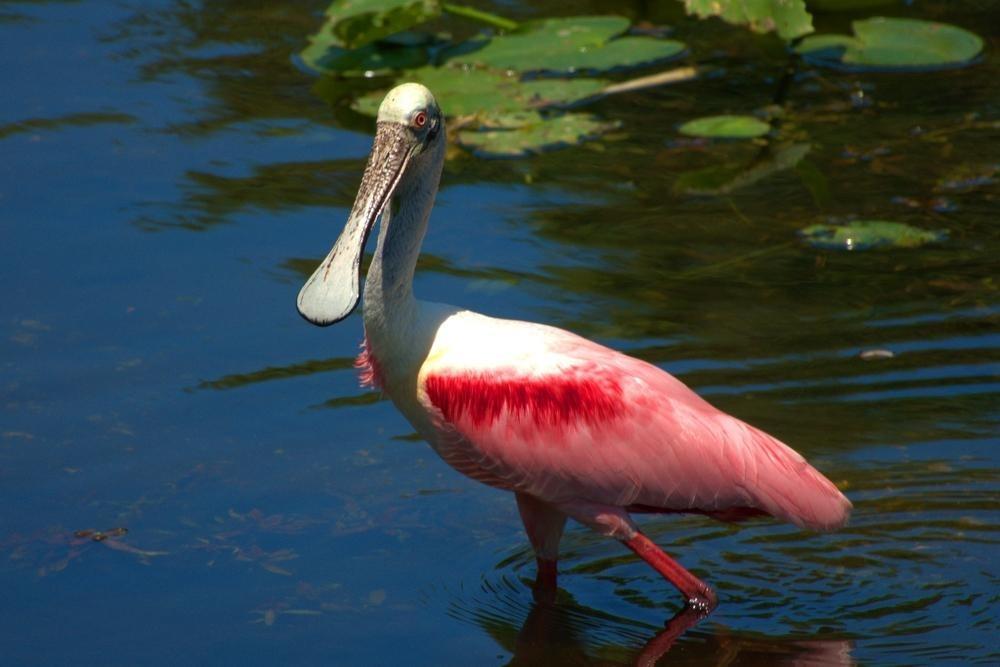
Their name, Roseate Spoonbill, literally hints at their most distinctive feature: a “spoonbill” has a bill shaped like a spoon. And that broad bill isn’t just a striking feature. It’s a highly specialized tool for finding food in shallow water.
Tampa Bay is especially interesting for this species because the bay is one of the few places in Florida where Roseate Spoonbills regularly nest. According to the Florida Fish and Wildlife Conservation Commission, Tampa Bay is one of the species’ primary areas of distribution in the state, with mangrove islands serving as typical nesting habitat.
Why Are They Pink?
The Roseate Spoonbill’s color can easily make you think of a flamingo, but it’s a completely different bird. Spoonbills belong to the ibis family and are close relatives of ibises.
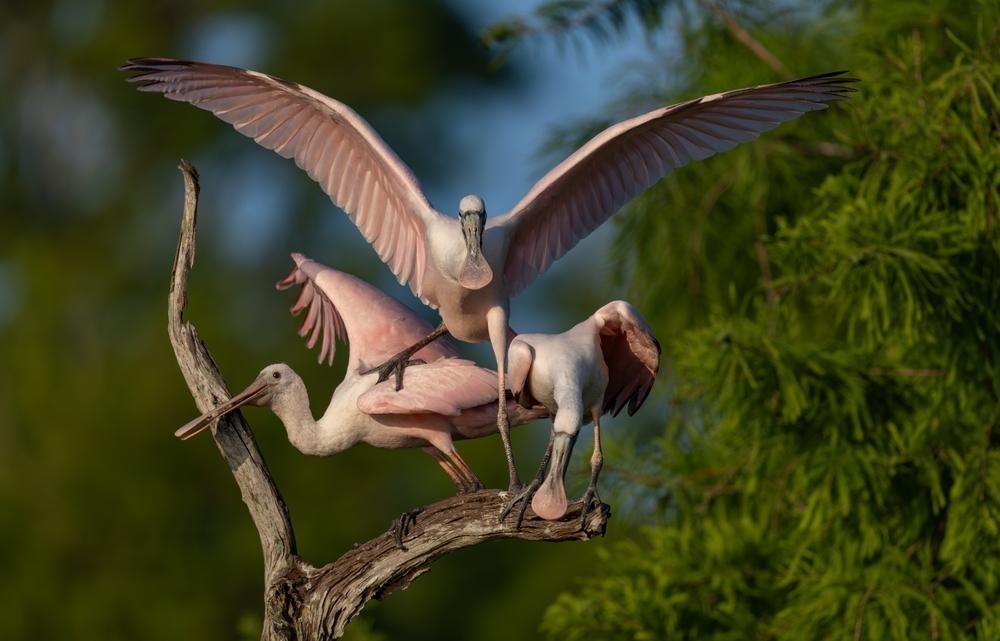
An adult bird’s plumage can range from pale pink to a rich pinkish-red. The shoulders and parts of the wings can be especially bright. An adult’s head is mostly featherless, with grayish-green skin, while the eyes have a reddish tint. Young spoonbills are much paler and can look almost white from a distance.
So if you see a group of pale spoonbills and wonder why they aren’t as bright as they look in photographs, they aren’t necessarily a different species. They may be young birds.

The Most Interesting Part Happens Right Under the Water
A Roseate Spoonbill doesn’t hunt the way a heron does, standing still and waiting for prey to come close.
Instead, it wades into shallow water and slowly moves forward while sweeping its bill from side to side. The partially open tips of the bill are highly sensitive and help the bird locate small fish, crustaceans, and other aquatic animals even in murky water.
That’s why it’s worth watching a spoonbill not only when it’s standing on the shore. The most interesting moment may come when the bird starts “mowing” through the water with its bill. If several birds are feeding nearby, you may see an entire group sweeping through the shallows in sync.
And for birdwatchers, one more detail matters here: water level.
Spoonbills need shallow enough water to reach organisms on the bottom. Low water levels and exposed shallow areas can create better conditions for watching them feed. Tampa Audubon, for example, specifically notes that during low tide at Picnic Island, spoonbills, other shorebirds, gulls, and terns may gather in the shallow areas.
Where to Look for Roseate Spoonbills in Tampa Bay
One of the most interesting places to watch them is Fort De Soto Park. The park combines beaches, mangroves, shallow waters, and other coastal habitats, so you can see not only spoonbills but also a wide variety of other wading and shorebirds.
Another interesting option is Upper Tampa Bay Park near Oldsmar. It combines shallow freshwater areas, pine habitat, mangroves, and the shoreline of Old Tampa Bay. It’s a good example of why you shouldn’t limit your search for spoonbills to beaches alone.
On the southern side of the bay, keep an eye on Cockroach Bay Aquatic Preserve. The name may sound funny, but the area is very serious from a conservation standpoint: it’s a large system of mangrove islands and salt marshes near the mouth of the Little Manatee River. Roseate Spoonbills, herons, pelicans, and other wading birds can regularly be found here.
And for those who want to watch birds closer to Tampa itself, Picnic Island Park is worth considering. Tampa Audubon recommends the southern end of the island and the overlook near the lagoon: during low tide, spoonbills, herons, shorebirds, gulls, and terns may gather in the nearby shallows.
Tampa Bay Is More Than Just a Place for Chance Encounters
For experienced birdwatchers, Tampa Bay is interesting because Roseate Spoonbills don’t just pass through here.
One well-known breeding area is the Richard T. Paul Alafia Bank Bird Sanctuary. Audubon research shows that spoonbills nest in the Tampa Bay area, and birds here are even banded for further study of their movements and behavior.
Another interesting example is Hooker’s Prairie. In 2021, Audubon reported approximately 30–40 pairs of Roseate Spoonbills using the area for breeding. That made it one of the largest colonies of the species in the region after Alafia Bank.
How Roseate Spoonbills Disappeared From Tampa Bay – and Came Back
Today, it’s hard to imagine the Tampa Bay shoreline without Roseate Spoonbills, but just a few decades ago, seeing a nesting colony of these birds here was practically impossible. Their disappearance was the result not of a single problem, but of a long history of human impact on Florida’s coastline.
During the 19th and early 20th centuries, Roseate Spoonbills were actively killed for their feathers. The feathers were especially valuable in the fashion industry, where pink and reddish feathers were used to decorate hats and women’s clothing. Birds were shot specifically when they gathered in large numbers at colonies, meaning the practice could cause enormous damage to populations.
This was particularly dangerous for spoonbills because of their colonial behavior. If people found a nesting site, they could destroy a significant portion of the breeding population all at once.
But feathers weren’t the only problem. The draining of wetlands, coastal development, and changes to wetland habitats gradually reduced the number of places where spoonbills could feed and nest. The species depends heavily on shallow coastal waters, mangrove islands, and other wetland habitats. When those areas disappear or change, the bird loses not just a place to live, but an entire system on which its reproduction depends.
A turning point came in the early 20th century, when the United States began imposing stricter restrictions on hunting waterfowl and trading in feathers. One key development was federal protection for migratory birds. At the same time, feather fashion gradually disappeared, while wetland conservation began to play an increasingly important role.
As a result, Roseate Spoonbills began returning to areas where they had previously disappeared as nesting birds. In Tampa Bay, this process became noticeable in the 1970s, when spoonbills began nesting here again after a long absence.
Their return wasn’t instantaneous. The birds needed safe places for colonies, enough shallow areas for feeding, and a relatively stable ecosystem. As these conditions began to recover, spoonbills gradually reestablished themselves in the region.
Tampa Bay’s mangrove islands played an especially important role, giving birds places to establish colonies away from most terrestrial predators and people. Today, the bay contains important Roseate Spoonbill breeding sites, including Alafia Bank Bird Sanctuary and other colonies throughout the region.
Interestingly, the species’ recovery doesn’t mean the story has a completely happy ending. Roseate Spoonbills still depend on the condition of wetlands, water levels, food availability, and the safety of nesting sites. That’s why their presence in Tampa Bay can serve as a kind of indicator of how well the coastal ecosystem is being preserved.
So when a flock of Roseate Spoonbills appears in the shallow waters of Tampa Bay today, it’s not simply a beautiful scene for a photograph. It’s the result of decades of changing attitudes toward wildlife — from hunting birds for fashion to establishing protected areas and monitoring programs.
And perhaps the most interesting part is that the Roseate Spoonbill has become a symbol not only of nature’s vulnerability, but also of its ability to recover when given the opportunity.
When Is the Best Time to Go Birdwatching?
When it comes to spoonbills, the time of day matters, but the condition of the water may matter even more.
Early morning or later in the afternoon is generally more comfortable for birdwatching: there’s less heat, less human activity, and better conditions for extended observation. But if your goal is specifically to watch the birds feeding, check the tides before you go.
During low tide, shallow waters and muddy areas are exposed, making it easier for spoonbills to find food. That’s when the bird may be more than just a beautiful pink shape on the horizon and instead become a true subject for observing behavior.
Experienced birdwatchers should also pay attention to eBird and current local sightings. The Cornell Lab map shows Roseate Spoonbill records from recent years, and fresh sightings can be much more useful than a universal list of “best places.”
What to Bring
For a chance encounter, a smartphone and a little patience are enough. But if you’re specifically heading out for birdwatching, binoculars can completely change the experience.
From a distance, a spoonbill may look like nothing more than a large pink bird. Through binoculars, you can see the shape of its bill, the coloring of its head, eyes, and wings, and watch exactly how it searches for food.
Photographers should keep in mind that Florida’s bright sunlight can make pink plumage look almost “neon,” while softer morning or evening light does a better job of capturing its subtle shades.
And don’t try to get closer just for a photograph. Mangrove islands and colonies where spoonbills nest are important breeding areas, and the species has threatened status in Florida and is protected by law.
If You See a Spoonbill With a Color Band
For an experienced birdwatcher, this can be the most interesting part of the encounter.
Audubon Florida has used color bands for many years to track the movements of Roseate Spoonbills. In 2026, Audubon specifically reported a resighting of a banded bird in Tampa Bay and emphasized that these records help researchers better understand the birds’ movements, behavior, and population dynamics.
So a photograph of a spoonbill with a clearly visible band may be more than just a great shot. It could potentially become part of scientific research.
That’s what makes birdwatching in Tampa Bay especially interesting: sometimes an ordinary walk by the water turns into a small field expedition. You may be looking not simply for a pink bird, but trying to determine its age, behavior, feeding technique, interactions with other species, and even attempting to read its color band.
And if a spoonbill is standing in shallow water, methodically sweeping its strange bill from side to side, it’s worth staying for a few more minutes. That’s when Tampa Bay reveals itself as a complex, living ecosystem where even a single pink bird can tell you a lot.


ABOUT TampaBayTide
FOR BUSINESS