


The Bird That Hunts Underwater and Looks Like a Snake


If you spot nothing but a long, snake-like neck gliding across the surface of a body of water in Florida, don't immediately worry about a snake bite. It could very well be an anhinga – an unusual water bird that hides most of its body underwater while hunting.
The anhinga (Anhinga anhinga) is a year-round resident of Florida and is especially well adapted to shallow freshwater bodies, swamps, slow-moving rivers, and quiet lagoons. In the Tampa Bay area, it is one of those birds you can spot without joining a dedicated birdwatching walk – all you need is to be near the right kind of water and know exactly what to look for.
The Bird That Learned How to Almost Sink
The anhinga's most remarkable feature begins with its feathers.
Most water birds have highly water-resistant feathers that help them stay on the surface, but not the anhinga. Its feathers become wet, while its body has relatively low buoyancy thanks to its dense bones and the properties of its plumage. As a result, the bird can dive much deeper than you might expect from a water bird.
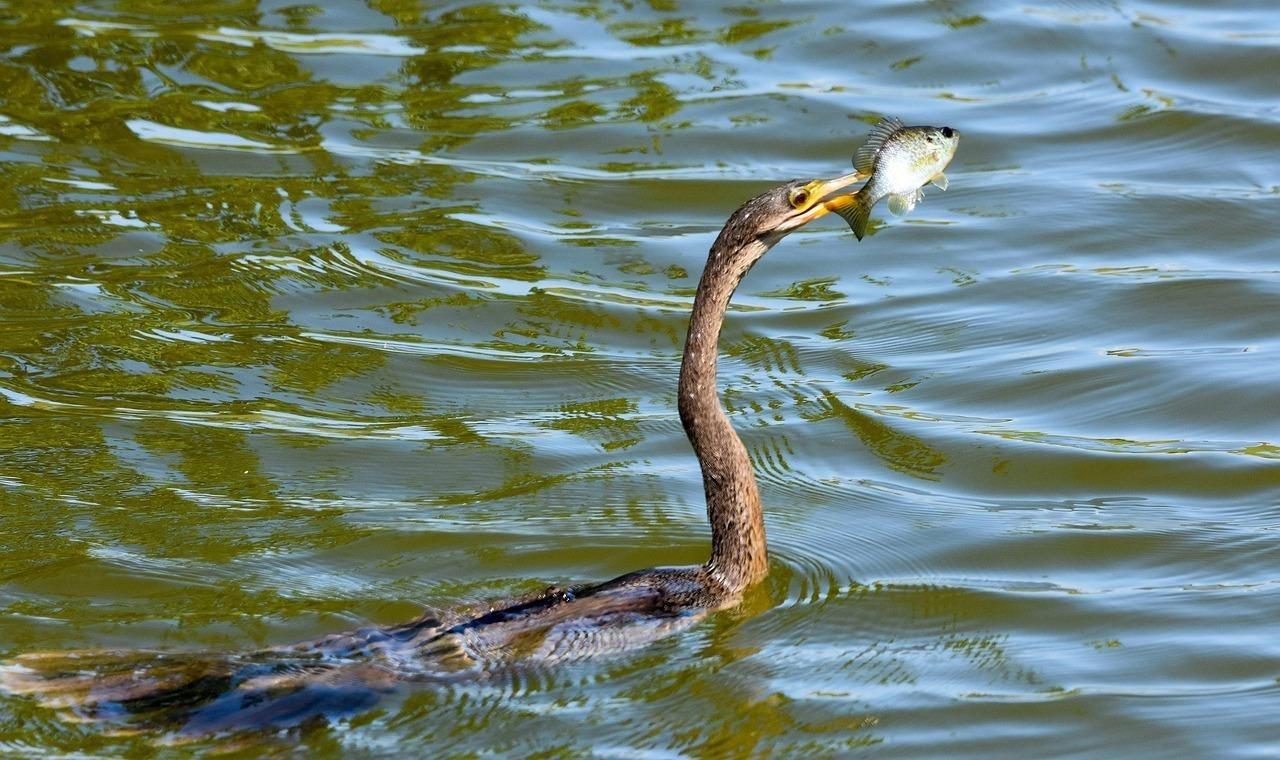
When swimming, sometimes you can see only the anhinga's head and neck above the water. Its head and long neck move slowly across the surface, while the rest of its body remains submerged. That's where one of the bird's best-known nicknames comes from – snakebird.
To someone seeing an anhinga for the first time, it can look almost surreal: it seems as though a snake with a beak is gliding through the water.
Its Beak Is More Than Just a Beak
The anhinga does not chase fish the way many other water birds do. It moves fairly slowly underwater, stalking its prey before suddenly thrusting its head forward.
Its long, straight bill resembles a small spear. The bird literally impales the fish with it before returning to the surface. The anhinga usually tosses its prey into the air, catches it, and swallows it headfirst. This technique works especially well for the small fish that make up most of its diet.
Interestingly, the structure of the anhinga's neck is also adapted to this hunting style. Inside the neck is a specialized mechanism that allows the bird to store and then rapidly release energy for movement. At the moment of attack, its head literally shoots forward.
So, if you are watching an anhinga underwater, the most interesting moment may last only a fraction of a second.
Why Does the Anhinga Always Sit With Its Wings Spread?
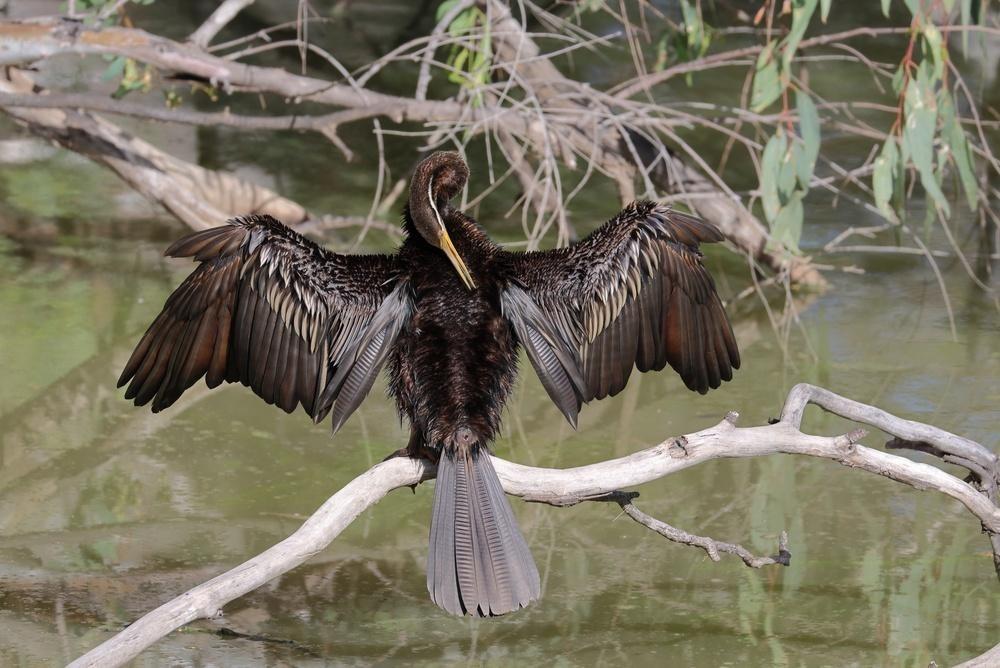
One of the most recognizable anhinga photographs shows the bird sitting on a branch, stump, or another surface rising above the water with its wings spread wide.
This is not simply a dramatic pose for the photographer or a lucky shot.
After diving, the anhinga's feathers become wet, so the bird needs to dry them while also warming itself. Anhingas often sit with their backs toward the sun, spreading their wings and tail. On cooler days, this posture helps not only dry their plumage but also absorb the sun's warmth.
This behavior also makes the anhinga one of the easiest water birds to observe. You do not necessarily have to spend hours searching through dense vegetation: sometimes all it takes is looking at the branches above the water and finding the characteristic dark silhouette with its wings spread.
Anhinga or Cormorant?
From a distance, it is easy to mistake an anhinga for a cormorant. Both birds are dark, swim well, dive, and often sit near the water with their wings spread.
But for birders, there are several simple clues.
Anhingas have longer tails, straight pointed bills, and much thinner, S-shaped necks. Cormorants have bills that hook downward at the tip, and when swimming, you can usually see not just the head and neck but also more of the back above the water. An anhinga, by contrast, can literally seem to "disappear" into the water, leaving only its head and neck above the surface.
There is another especially useful clue. When an anhinga flies, its long neck and tail create a very distinctive silhouette. With its wings spread, the bird can resemble a cross soaring through the sky. Anhingas make good use of thermal updrafts and can gain considerable altitude, so sometimes you should look for them not beside the water, but directly above it.
Black, Brown, and a Little Bit of Blue
An adult male anhinga is hard to miss up close. Its plumage is mostly black, with distinctive silvery-white areas on the wings and back. During breeding season, a bright blue patch of bare skin around the eyes becomes especially noticeable. Females look quite different: their heads and necks are lighter, with brownish-beige coloring. Juveniles are more similar in coloration to females until they reach maturity.
Anhingas should not be identified by color alone. Body shape, tail length, neck structure, and swimming behavior are much more reliable for identification.
Anhingas Have Their Own Way of Getting Acquainted
Anhinga breeding behavior also has some interesting details, especially when you observe them in a colony.
These birds often nest in groups alongside other water birds – herons, egrets, ibises, cormorants, and other species. The male first selects a location for a potential nest and displays it to the female. Courtship behavior can include spreading the wings, raising the tail over the back, throwing the bill upward, and making deep bows.
Once a pair forms, the male brings nesting material, while the female does most of the nest building. The nest is usually located in a tree near the water or directly over the water.
Both parents incubate the eggs, and after the chicks hatch, they feed the young together. Young anhingas have another interesting ability: if disturbed at around two weeks old, they can jump from the nest into the water and later attempt to climb back up, using their bills and feet to scramble up the tree.
Where to Look for Anhingas in Tampa Bay
For anhingas, it is less about being close to the open bay and more about having calm water, vegetation, and convenient branches where they can rest and dry their wings. The species is primarily associated with shallow, quiet bodies of water, swamps, ponds, and slow-moving rivers, although it can also use coastal brackish waters.
One place to try is Lettuce Lake Park in Tampa. The park stretches along the Hillsborough River and features a long boardwalk through a forested wetland area. Tampa Audubon calls it a birding hotspot, with more than 180 bird species recorded there, including herons, limpkins, ospreys, and other species commonly found around the water and surrounding habitats.
On the other side of Tampa Bay, pay attention to Weedon Island Preserve in St. Petersburg. This large natural area on the shore of Old Tampa Bay includes both aquatic and terrestrial ecosystems, more than 4.7 miles of trails and boardwalks, and a well-established reputation as a birdwatching destination. Here, it is especially worthwhile to look for birds not on open water, but along vegetation, channels, and areas with trees and other places where they can perch.
Another option for those willing to venture beyond Tampa and St. Petersburg is the Lower Hillsborough Wildlife Management Area and the natural areas along the Hillsborough River. For more serious birdwatching, consider Circle B Bar Reserve near Lakeland. Anhingas are regularly recorded there, and local birders describe them as one of the reserve's more visible water birds.
The best places to look for anhingas are where shallow water meets trees, shrubs, snags, or other convenient perches. Pay particular attention to branches hanging over the water and open spots where a bird may spread its wings to dry.
Do not limit your search to the water's surface. If an anhinga has just finished feeding, it may sit motionless on a branch, while later in the warm part of the day it may rise high into the air on thermal currents. In the sky, its long neck and tail can be almost as noticeable as its spread wings on a branch.
And, of course, binoculars can make this kind of observation much more rewarding. From a distance, an anhinga may look like nothing more than a dark bird, but through optics you can see the silvery feathers on a male's wings, the shape of its bill, the texture of its plumage, and, during breeding season, the bright blue skin around its eyes.
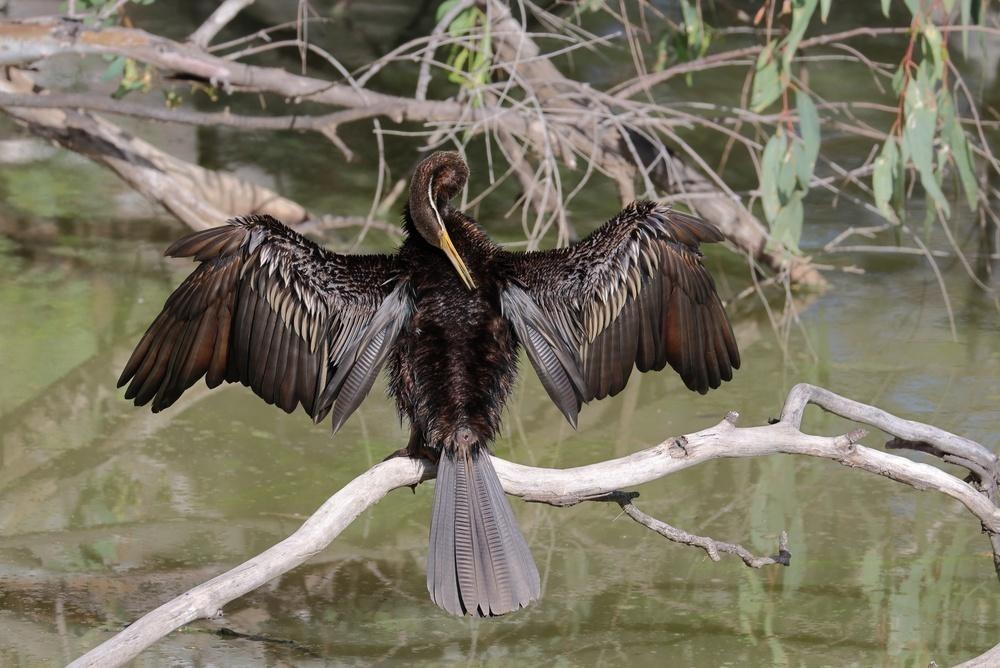
Anhingas are interesting because during a single observation, they can show several completely different forms. First, you see a "snake" that almost completely disappears underwater. Then, a hunter that strikes a fish with its bill in a split second. A few minutes later, the same bird may be sitting on a branch with its wings spread, and later still, it can become a small cross-shaped silhouette soaring high above the water.
That is exactly what makes the anhinga interesting not only to experienced birdwatchers. It is a good example of how unusual the everyday residents of Florida can be - birds that are easy to overlook during an ordinary walk.
The next time a long neck appears on the water with no visible body, take a closer look. You may have just found your anhinga.


ABOUT TampaBayTide
FOR BUSINESS