


Florida’s Sky Pirates: The Seabirds That Almost Never Touch the Water

If you enjoy spending time around the bay, you’ve probably noticed large, dark birds with unusually long wings and forked tails soaring over the water. They can circle in the sky for hours, barely flapping their wings, and sometimes it seems as though the bird is simply suspended above the bay, riding invisible currents of air.
These are frigatebirds – some of Florida’s most unusual seabirds. They’re easy to recognize once you know what to look for, but it’s even more fascinating to learn how they manage to live over the sea while barely ever landing on the water.
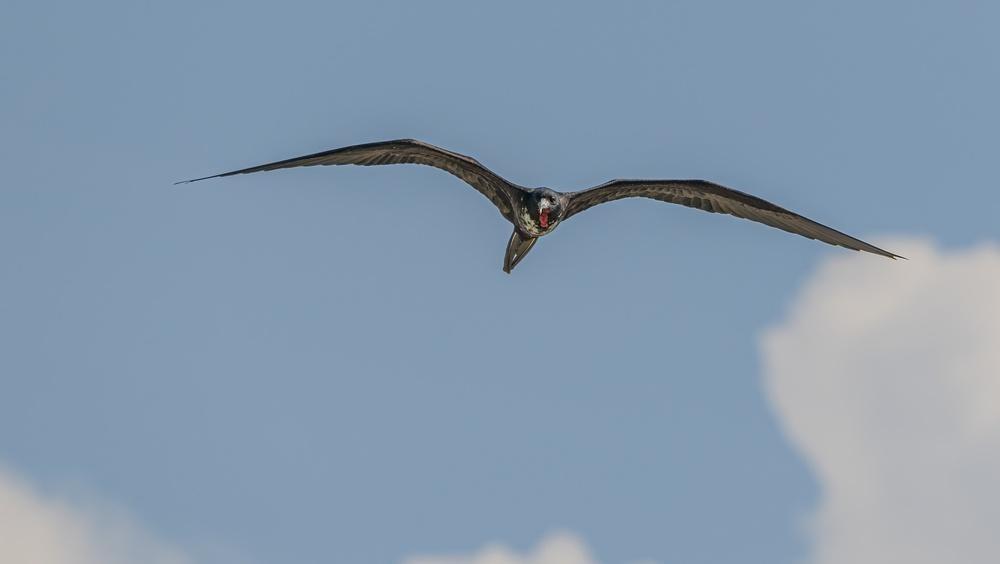
Let’s start with a fact that seems almost impossible for a seabird: frigatebirds aren’t built for swimming.
Most seabirds have dense, waterproof feathers that allow them to land on the water, swim, or dive for fish. Frigatebirds don’t. Their feathers aren’t waterproof enough, and their body structure doesn’t allow them to comfortably stay on the surface of the sea. If a frigatebird lands on the water, it can have a hard time taking off again.
So it simply avoids that situation. A frigatebird catches prey from the air or snatches it from the very surface of the water without diving into it. Its long wings and lightweight body are perfectly adapted to this way of life.
That’s where one of the most fascinating things about these birds begins: the frigatebird has essentially turned the sky into its primary habitat.
Wings Built for Flight
If you look at a frigatebird in the sky, its wings seem disproportionately large compared with its body. That’s no accident.
The Magnificent Frigatebird, which can be found in Florida, has a wingspan of about 7.5 feet, and its narrow wings are perfectly suited for soaring. A frigatebird can use rising air currents to gain altitude and then glide for long periods with barely a wingbeat.
To an observer, it can look as though the bird is simply floating through the sky. In reality, this flight technique allows the frigatebird to use much less energy. For a bird that spends an enormous amount of time in the air and can travel considerable distances over the sea, that’s a major advantage.
So the next time you see a large bird over Tampa Bay circling above the water with barely any wing movement, don’t immediately look for it on the shore. It may have no intention of landing there at all.
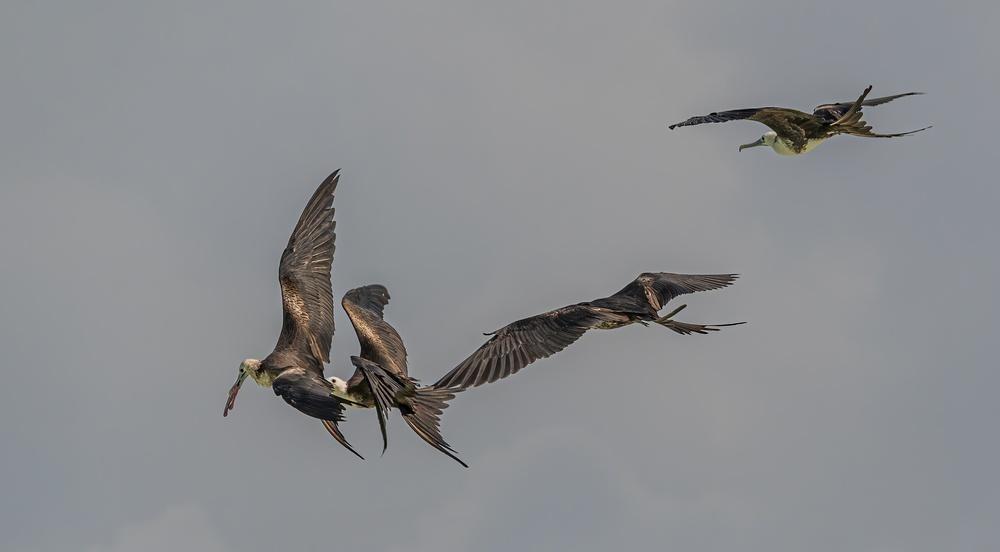
A frigatebird isn’t just an expert flyer. It also knows how to put someone else’s work to use.
These birds are known for a behavior called kleptoparasitism – in simple terms, a frigatebird may chase another seabird and force it to drop its prey. As soon as the food is in the air, the frigatebird swiftly snatches it.
That’s why frigatebirds are sometimes called sea pirates. This strategy works especially well because of their maneuverability. A frigatebird can chase another bird through the air, make sharp turns, and catch prey in midflight.
That doesn’t mean frigatebirds survive entirely by stealing. They also catch small fish and other marine animals themselves, pick food from the surface of the water, and take advantage of opportunities created by human activity.
Still, watching a frigatebird chase another bird is one of the most fascinating scenes a birdwatcher can witness along the coast.
The Red Balloon
There’s another reason why a frigatebird is hard to confuse with any other bird.
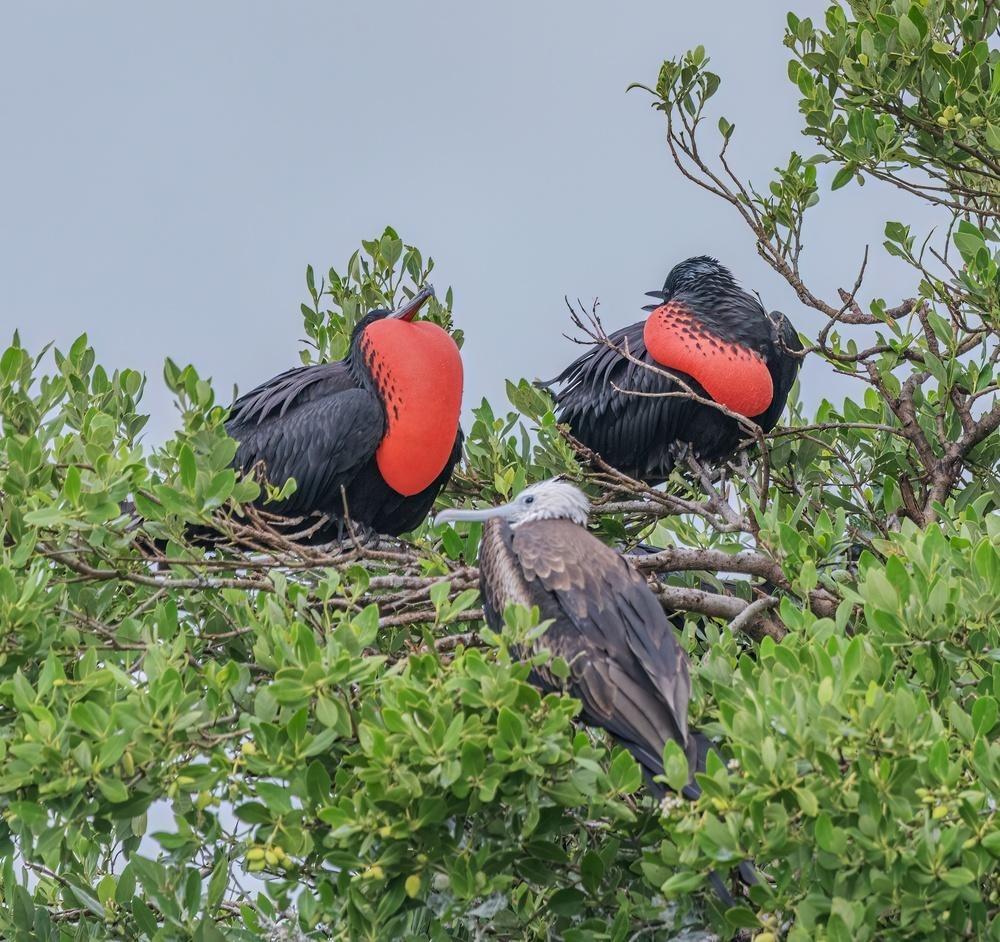
An adult male Magnificent Frigatebird has a bright red throat pouch. Under normal circumstances, it’s barely noticeable, but during mating season, the male inflates it, turning it into a huge red balloon.
And that’s only part of the show. The male sits on a branch or another convenient surface, spreads his wings, moves his head, snaps his bill, and displays his bright throat pouch. For a female, it’s a kind of performance in which the male is trying to get her attention.
When several males gather nearby and display their red throat pouches at the same time, a frigatebird colony can be especially spectacular.
Females look completely different. They don’t have the bright red throat pouch, and adult females are easy to recognize by the white front of their bodies.
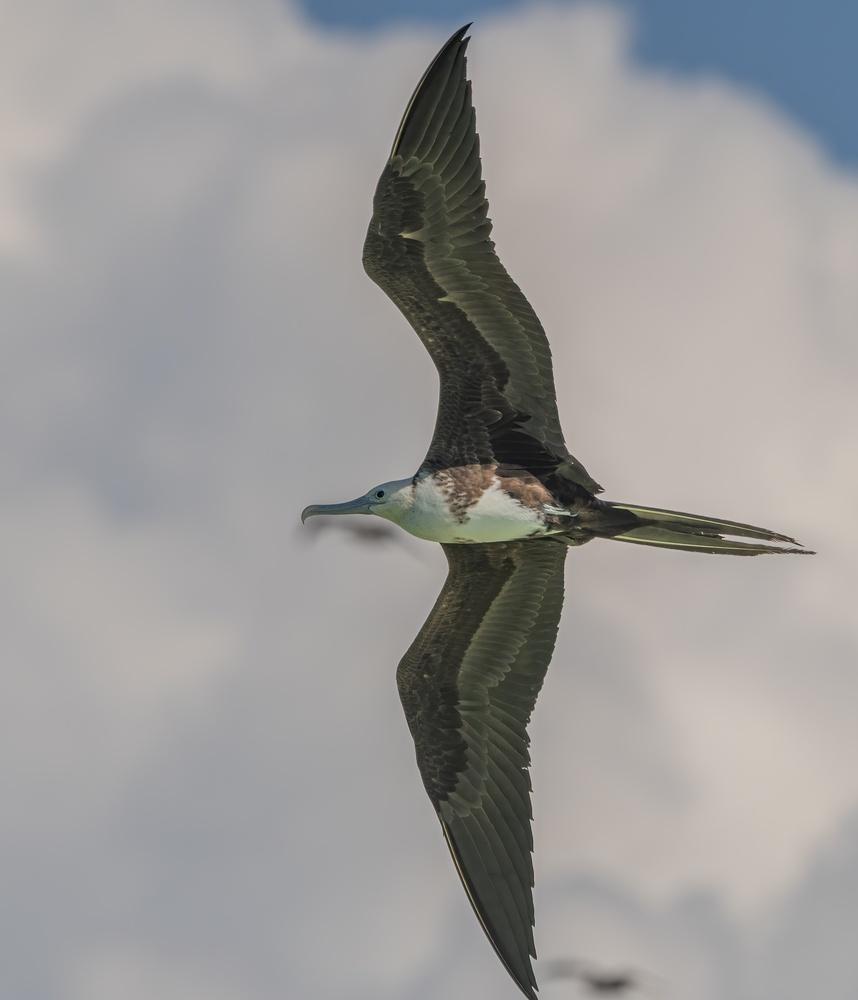
It’s best to start with the silhouette rather than the color. A frigatebird has very long, narrow wings, a long forked tail, and a long bill with a distinctive hooked tip. In flight, its body appears relatively small compared with the enormous surface area of its wings.
An adult male is almost entirely black, and his red throat pouch is clearly visible only when he is displaying it. In a female, the white area on the chest and neck creates a noticeable contrast with the dark body.
Young birds look different again: their heads are much lighter, and their coloring gradually changes as they mature.
You can also try to distinguish a frigatebird from other large birds by its flight. It often soars high above the water, using air currents, and can remain almost motionless relative to the air for long periods. Its forked tail is easy to spot, especially when the bird turns in flight.
Where to Look for Frigatebirds in Tampa Bay
Frigatebirds are associated with warm coastal and marine areas, so Tampa Bay is a natural place to encounter them. They can often be seen along the Gulf Beaches, especially around Fort De Soto Park, which offers beaches, shallow waters, and good vantage points. You may also have a good chance of seeing them near Skyway Fishing Pier State Park – birds often fly along the Sunshine Skyway, using the air currents over the bay. Another good spot is Egmont Key, where the combination of open water and relatively little human activity attracts many seabirds, including frigatebirds.
However, you need to look for them differently than birds that stay along the shoreline. A frigatebird may be far from shore or high above the water, so the best strategy for a birdwatcher is to look up from time to time and watch not only the surface of the bay but also the sky above it.
It can be especially interesting to watch the birds when they’re using rising air currents. If several frigatebirds are circling in roughly the same area, it may be a sign of favorable conditions for soaring.
It’s also worth paying attention to the behavior of other seabirds. If a chase suddenly breaks out over the water, a large dark bird with a forked tail may very well be a frigatebird that has decided to take advantage of someone else’s catch.
Frigatebirds are fascinating not just because of their individual unusual traits. Their entire lives seem to revolve around one main idea: staying in the air for as long as possible.
They don’t swim, dive, or hunt the way many other seabirds do. Instead, they use their enormous wings, air currents, sharp eyesight, and remarkable maneuverability to find food without leaving the sky.
That’s exactly why the frigatebird fits so well into the Tampa Bay landscape. You might miss it while looking at the water, but look up – and there may be a bird above the bay that has already been soaring there for many minutes or even hours, barely spending any energy on a single wingbeat.


ABOUT TampaBayTide
FOR BUSINESS