


The Bald Eagles Living in Plain Sight Around Tampa Bay


If you spend enough time near the water, sooner or later a large bird of prey with broad wings will appear overhead. It may slowly circle above the bay, perch on the top of a tree, or suddenly dive toward the water after a fish.
The bald eagle has become such a familiar part of the Florida landscape that it is easy to think of it as just another large bird. In reality, it is one of Tampa Bay’s most fascinating residents – and October is an especially good reminder of that. This is when a new nesting season begins in Florida: eagles return to their nests, repair them and prepare for the arrival of their young.

Adult bald eagles are the easiest to recognize: a dark brown body, white head and white tail, with a yellow beak and feet. But if a bird looks mostly brown, that does not mean you are looking at a different species.
Young eagles are not born with white heads. Their plumage remains mostly dark during their first few years, with white patches that gradually change. The distinctive adult coloring develops by around the fifth or sixth year of life. That is why a young eagle flying over the water can easily be mistaken for another large bird of prey.
Their Nests Can Be Enormous
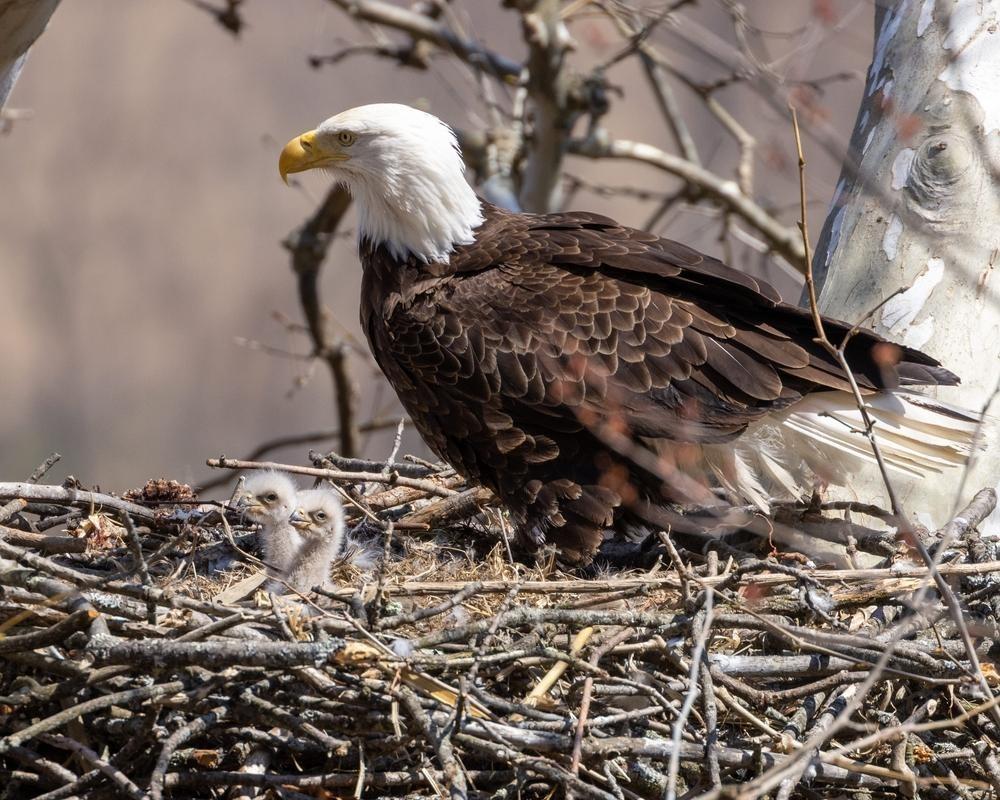
One of the most impressive things about bald eagles is their nests. The birds use large branches and then repair and expand the structure year after year. What begins as an ordinary nest can gradually become a massive wooden structure.
Florida has a record-setting example in St. Petersburg: a bald eagle nest measured 9.5 feet in diameter and about 20 feet tall. To put that in perspective, it is more like a small room in a tree than what most people picture when they hear the word “nest.”
Bald eagles can also have more than one nest within their territory. If one structure becomes unsuitable, a pair may move to another without leaving the territory they know. In Florida, most nests are located near water, since that is where the birds find much of their food.
Tampa Bay Has an Unusual Feature
When we picture an eagle’s nest, we most likely imagine a tall tree. In the modern world, the picture can look very different.
Bald eagles are increasingly using artificial structures – including cell towers and other tall structures. This is particularly noticeable in Pinellas and Hillsborough counties. Audubon Florida has reported that about 60% of bald eagle nests in these counties are located on artificial structures.
It is a pretty unusual kind of neighborhood: the American national symbol building a huge nest on a structure people use for cellular communication.
The reason is largely practical. Eagles need a high location with a good view, close to water and feeding areas. In a region where the natural landscape is constantly changing because of urban development, there are fewer suitable large trees. So the birds use what is available.
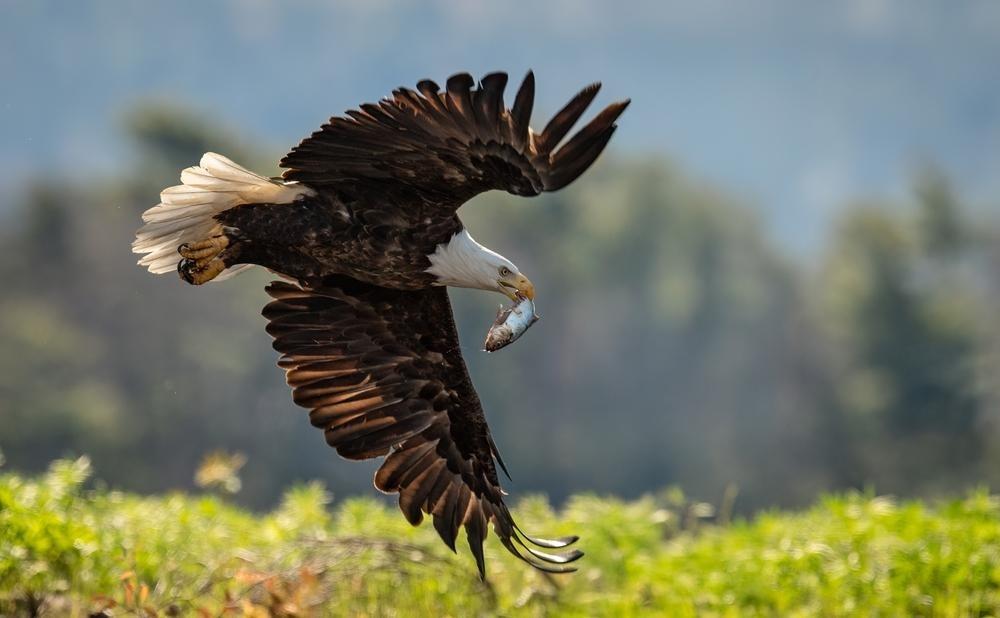
Bald eagles are usually associated with strength, hunting and flight. But their menu is considerably less romantic.
Eagles do catch fish, often snatching them from the water with their talons. However, they are opportunistic predators. If there is an easier way to get food, they do not necessarily spend the energy hunting.
Bald eagles can eat carrion and catch birds, mammals, reptiles and other animals. They are also known for stealing food from other birds of prey. An osprey that has just caught a fish can sometimes become the target of an eagle pirate.
So when watching an eagle near the water, it is worth looking beyond the eagle itself. Sometimes the most interesting part begins when another bird carrying food appears nearby.
The Hunt Takes Seconds
A bald eagle can appear completely motionless for hours. It sits on a branch, pole or another high point and simply looks down.
Then everything happens almost instantly.
The bird spreads its enormous wings, drops toward the ground and extends its feet forward, trying to grab its prey with its talons. Over the water, the attack is especially impressive because an eagle can fly very low over the surface before snatching a fish.
For someone simply walking along the water, it can look like a sudden burst of motion in the middle of an otherwise completely peaceful landscape.
Their History in the U.S. Was Far More Dramatic
Today, the bald eagle seems like one of the most familiar symbols of American nature. But that was not always the case.
After years of persecution, habitat loss and, especially, widespread use of the pesticide DDT, eagle populations declined dramatically. The ban on DDT in 1972 became one of the important turning points for the species.
In Florida, the population began to recover particularly noticeably. The Florida Fish and Wildlife Conservation Commission (FWC) reports that during the 2023-2024 season, 1,488 nests were documented across 55 counties in the state. By comparison, there were only 88 active pairs in Florida in 1973.
Thanks to the species’ recovery, the bald eagle was removed from the federal list of endangered species in 2007 and from Florida’s list of threatened species in 2008. That does not mean the birds are no longer protected: they continue to be protected under federal and state law.
October Marks the Start of a New Season
This is the time of year in Florida when bald eagles become especially interesting to watch.
In September and October, pairs begin returning to their nests and adding new material to the familiar structure. Many pairs lay eggs in December or early January, and incubation lasts about 34-36 days. Young birds remain in the nest for about 10-12 weeks and make their first flights at around 12 weeks of age.
In other words, the large bird you see in the fall near a familiar tree may be busy with something much more important than simply sitting on a branch.
For the eagles, it is the beginning of a new cycle that will continue for many months.
Young Eagles Do Not Rush to Leave Their Parents
Even after their first flight, a young eagle is not yet completely independent.
Young birds may remain near the nest while continuing to receive food from their parents. They gradually learn to fly, hunt and find food on their own. Fully adult plumage develops only after several years.
That means the very large brown eagle you spot in a tree could easily be a young bird that has not yet developed its famous white head.
How to Watch Eagles Without Disturbing Them
In Tampa Bay, you can encounter a bald eagle much closer to the city than you might expect. But good wildlife watching does not necessarily mean watching from up close.
For a photographer or birdwatcher, the best option is to use binoculars or a lens with good magnification and remain a safe distance from the nest. It is especially important not to try to get closer for a photograph during nesting season.
Bald eagles are territorial when nesting, and human disturbance can cause adult birds to leave the nest or expend extra energy defending their territory. That is why Florida has the large-scale Audubon EagleWatch program: hundreds of volunteers monitor more than a thousand nests and report changes and potential threats.
If you happen to see an eagle while out for a walk, the best approach is simple: stop, watch and let it continue doing its thing.
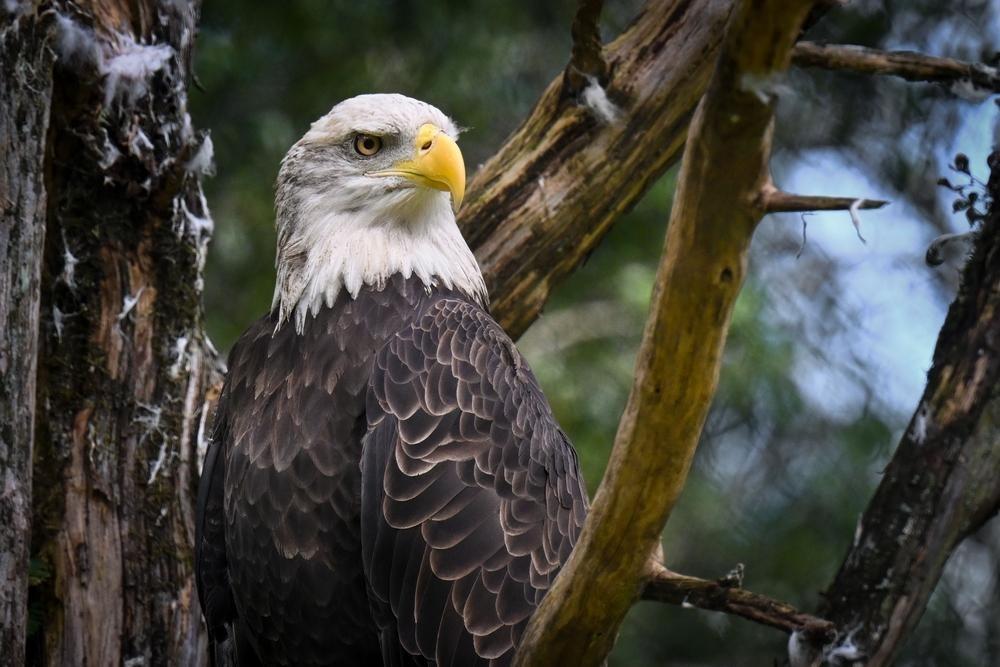
These birds survived a period when their numbers were falling rapidly, and today they once again nest in the thousands across the state. At the same time, their return does not mean that all the problems have disappeared. Habitat loss, nest destruction, collisions with vehicles, electrocution and other human-related factors remain threats.
Eagles have adapted to a landscape where the bay, mangroves, residential neighborhoods, roads, tall trees and urban infrastructure exist side by side. Some build their nests in trees, while others use structures that people created for completely different purposes.
So the next time a large bird with broad wings slowly flies over Tampa Bay, take a closer look. It may not simply be a familiar American symbol, but a wild predator that has already spent hours hunting, defending its territory, looking for a mate or simply watching the bay from the top of a tree.
And if it seems remarkably calm, do not be too quick to consider it passive. The bald eagle is simply very good at waiting.


ABOUT TampaBayTide
FOR BUSINESS