


Exploring the Historic Streets and Beaches of Pass-a-Grille


At the southern end of St. Pete Beach lies Pass-a-Grille, a small coastal neighborhood where the beach plays an important role but is far from the only thing to see. Historic buildings, small hotels, restaurants, and shops remain alongside the wide stretch of sand, while the central part of the neighborhood is well suited to exploring on foot.
In early October, Pass-a-Grille is especially well suited to this type of getaway. The summer heat gradually eases, while the water remains warm: the average water temperature in the St. Pete-Clearwater area is around 81°F, and the average daytime high is around 83°F. Fall is also generally quieter than the summer months.
Pass-a-Grille Is More Than Just a Beach
Pass-a-Grille is located on the southern part of the barrier island of Long Key, within St. Pete Beach. Its main characteristic is the way the beach is closely intertwined with a small historic neighborhood.
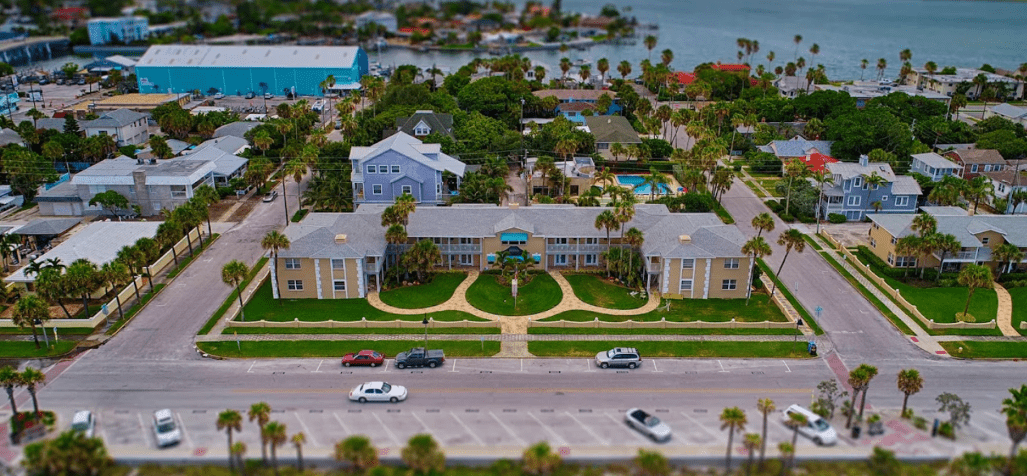
Unlike many popular Florida beach districts, Pass-a-Grille is not lined with a continuous row of large hotels and high-rises along the shore. A much smaller scale of development remains here: small houses, cottages, hotels, and commercial buildings are spread among streets that give the neighborhood its historic character.
The history of Pass-a-Grille began long before the modern resort appeared. For thousands of years, Indigenous peoples used the area around present-day St. Pete Beach, hunting and fishing on the islands and in the surrounding waters. European explorers arrived here in the 16th century: in 1528, the Spanish expedition led by Pánfilo de Narváez was among the first recorded European expeditions to reach this part of the coast.
Later, the barrier island became a place where fishermen stopped to collect fresh water, prepare their catch, and wait out bad weather. The origin of the name Pass-a-Grille is associated with this fishing past. One of the most common theories traces it to the French Passe aux Grilleurs, which can roughly be translated as “passage for those who grill.”
In the 19th century, the area gradually began transforming from a remote fishing camp into a resort. In 1857, John Gomez, who called himself the “last pirate,” began bringing visitors from Tampa here for recreation. This practice made Pass-a-Grille one of the oldest resort destinations on Florida’s central west coast.
Zephaniah Phillips, who settled here in the 1880s, is considered Pass-a-Grille’s first permanent resident. By 1895, plans were already underway for the island’s first residential development, Morey Beach. Development was slow, however: the island remained isolated, and it could mostly be reached by an irregular ferry service.
The situation changed in the early 20th century as transportation improved. In 1905, the railroad reached Gulfport on the other side of Boca Ciega Bay. From there, passengers were transported to Pass-a-Grille by a small steamboat, the Althea, which could carry about 50 passengers and made three trips a day. This made the beach neighborhood much more accessible to visitors from the mainland.
It was during this period that Pass-a-Grille began taking on the characteristics of a true resort. The first hotels and tourist infrastructure appeared in the early 1900s. One important building was Bonhomie, opened early in the century by French travel agent Georges Henri Lisot. Bathing pavilions, shops, restaurants, and other establishments serving not only permanent residents but also visitors began to appear.
In 1911, Pass-a-Grille became a separate municipality. At that point, there were only about 15–20 houses, several shops, a restaurant, and three hotels. The town began developing its own infrastructure: roads were laid, a water system was built, and electric lighting was installed. Before a centralized water system was available, residents collected rainwater in cisterns and used a natural spring.
The center of the new town was 6th Avenue, which was later renamed 8th Avenue. Most of the shops and tourist establishments were concentrated here. In 1914, the street was paved, making it the first paved road on the beaches in this part of the coast. After the streets were renumbered in the 1920s, the former 6th Avenue became today’s 8th Avenue, which remains the commercial center of Pass-a-Grille. Part of the historic paving on the street has survived.
In the 1920s, Pass-a-Grille experienced a period of active development. 8th Avenue was home to a grocery store, pharmacy, barbershop, mechanic’s shop, several small hotels, and a real estate office. A school was already operating on the island, and the number of permanent residents was growing. However, it was during this period that the neighborhood faced a series of disasters that changed its subsequent history.
In October 1921, a powerful hurricane struck the coast. Pass-a-Grille avoided the worst effects of the storm surge, but it was flooded, and the Pass-a-Grille Hotel was seriously damaged. The dance pavilion near the pier was also destroyed. The following year, a fire destroyed the Holloway Hotel, Mason Hotel, and approximately half of the other buildings on 8th Avenue. Later that same year, the hurricane-damaged Pass-a-Grille Hotel also burned. It was never rebuilt, and the property was eventually divided into residential lots.
Despite these losses, Pass-a-Grille continued to develop. The neighborhood gradually shifted from a large resort complex to a small coastal community with homes, small hotels, shops, and restaurants. This scale of development largely explains its appearance today: instead of a continuous line of high-rises, small historic structures remain alongside modern establishments.
In 1957, Pass-a-Grille lost its status as a separate municipality when it merged with neighboring beach towns to form the new city of St. Petersburg Beach. In 1994, the city’s name was changed to St. Pete Beach.
Much of the older development survived. In 1989, the Pass-a-Grille Historic District was added to the National Register of Historic Places. Initially, the historic district covered an area roughly between 4th and 12th Avenues, Gulf Boulevard, and Gulf Avenue; in 2003, its boundaries were expanded to include a much larger portion of the historic development. The National Register identifies several important periods in the district’s development, from the first decades of the 20th century through the postwar era.
That is why modern Pass-a-Grille is worth seeing as more than just a beach at the southern end of St. Pete Beach. Its small buildings, old streets, 8th Avenue, and remnants of its early tourist infrastructure are all parts of the history of a place that evolved from a fishing stop and an isolated island into one of the oldest beach resorts on this coast. That history also helps explain why Pass-a-Grille has a scale and appearance so different from larger resorts today.
One of the places where the character of Pass-a-Grille is easiest to experience is the area around 8th Avenue. Restaurants, small shops, hotels, and other businesses are concentrated here, so there is no need to drive anywhere after the beach to continue your walk. The compact size of Pass-a-Grille makes it convenient for a slow day by the bay. You can leave your car, walk along the beach, then move a few blocks into the neighborhood and spend time away from the water, surrounded by the local architecture.
In fall, this is especially fitting: as daytime temperatures become more comfortable for longer walks, Pass-a-Grille can be enjoyed not simply as a destination for beach time, but as a neighborhood that is easy to explore on foot.
Four Miles of Beach
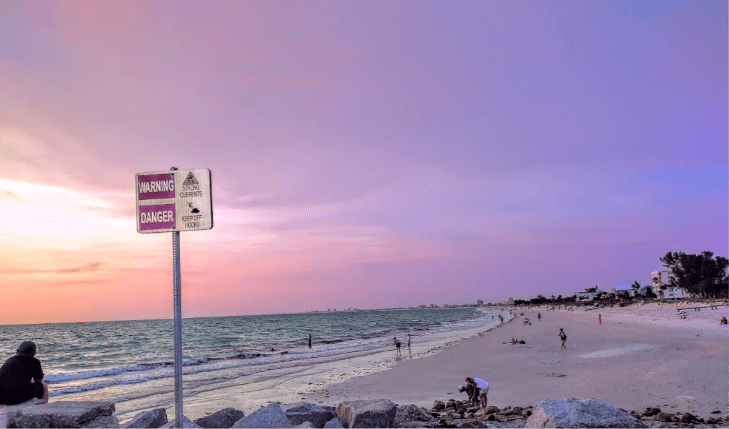
Pass-a-Grille Beach itself remains the area’s main natural attraction. The shoreline stretches for approximately four miles, with paths through dunes covered in sea oats and other coastal vegetation connecting the streets to the sand.
The wide beach makes it possible to go beyond a single spot near the main entrance. You can simply walk along the water, choosing your pace and distance depending on the weather.
In early October, the water is still warm enough for swimming. At the same time, air temperatures are no longer as high as they are in the middle of summer, so the beach can be combined with a more active walk rather than necessarily spending the entire day lying on the sand. Average conditions do not guarantee specific weather on a particular date, so it is worth checking the forecast and current beach conditions before your trip.
For those arriving with a dog, Pass-a-Grille has an important distinction. Dogs are not allowed on the Gulf of Mexico beach, but a separate dog-friendly area is located on the bay side near the southern end of Pass-a-Grille. This does not mean dogs can walk along the entire shoreline, so check the city’s current rules before your trip and stay within the designated areas.
Sunset Over the Gulf of Mexico
Sunset is one reason to stay in Pass-a-Grille into the evening. The beach’s western orientation opens up a wide horizon over the Gulf of Mexico, so an evening walk here can become a separate part of the trip rather than simply the end of a beach day.
This is especially enjoyable in fall, when evening temperatures gradually become cooler. After a walk on the beach, you can return to the central part of the neighborhood, where restaurants and other businesses are open.
Pass-a-Grille is a good example of why Tampa Bay’s beach neighborhoods should not be judged by the beach alone. There is a long stretch of sandy shoreline here, but alongside it is a historic neighborhood with its own architecture, small center, restaurants, and shops.
Pass-a-Grille is worth keeping on the list of places for a fall weekend in Tampa Bay - not as just another beach visited only for sand and water, but as a small coastal neighborhood that can be explored at an unhurried pace over the course of a few hours.


ABOUT TampaBayTide
FOR BUSINESS